
THE BOOK

The Micro Firm

The Atomic Unit of Ownership in an AI-Native Economy

The firm multiplied the person.

Now intelligence multiplies the firm, and the firm fits inside one person.

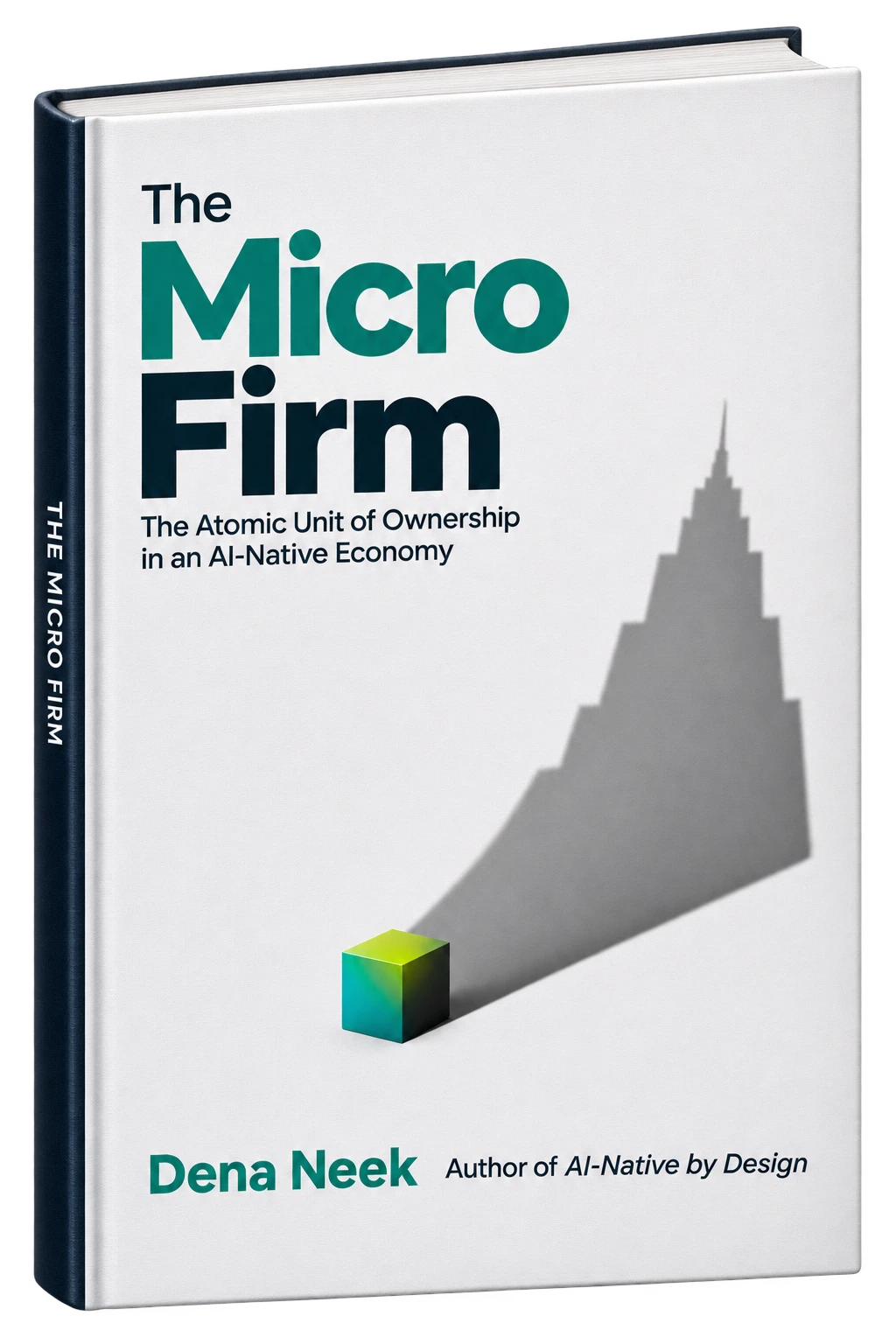
The cover of The Micro Firm: The Atomic Unit of Ownership in an AI-Native Economy, by Dena Neek.

Every era builds the unit its constraint requires

  1. WORKSHOP

    The workshop held production when tools were simple.

  2. FACTORY

    The factory gathered machines, energy, and labor under one roof because they had to sit in one place to work.

  3. CORPORATION

    The corporation gathered managers and departments because information couldn’t yet move, remember, or govern itself.

  4. PLATFORM

    The platform gathered users because distribution became the bottleneck.

Each unit was an answer to the most expensive problem of its time. None of them was permanent.

The company was the floor. The floor just dropped.

For a hundred years, building anything serious meant building a company. Not because companies were sacred, but because one person couldn’t afford what serious work required: coordinating many hands, remembering every promise, and being trusted with consequential work.

Those costs are collapsing.

  • Coordination

    no longer needs a manager between every two functions. It can be designed into a governed system.

  • Memory

    no longer lives in people’s heads and leaves every evening. It persists in a layer the firm can act on.

  • Trust

    no longer needs an institution big enough to vouch for you. Proof, permissions, and approvals can be built into the work itself.

When coordination, memory, and trust no longer require a corporation to hold them, the smallest serious unit of the economy changes shape.

That unit is the Microfirm

A Microfirm is not a small business. It’s not a freelancer with better software, and it’s not a startup that hasn’t grown yet.

It is a firm with company-level capacity at a fraction of company scale. A few humans own the judgment. A system of intelligence carries the coordination, the memory, and the execution.

Micro describes how many people it has, not what it can do. It can be small and still serious.

The future is not entrepreneurship. It’s ownership.

The old bargain

The old bargain gave you two choices: sell your labor into someone else’s system, or build a company big enough to own one.

The new bargain

The new bargain is simpler: own a governed system, and let it grow as far as its architecture can carry it.

AI doesn’t decide which side of that bargain you end up on. The same technology creates tenants as easily as owners. What decides it is what you build, and whether you own it.

Starting is easy now. Compounding is the whole game.

When the cost of starting collapses, everyone starts. A crowded field is not an outcome.

Most new firms will do good work and end the decade where they began, because nothing they did turned into something they kept.

A few will build assets that get more valuable with every customer:

  1. Deep memory of their industry

  2. Methods clean enough to hand to others

  3. A record others rely on

  4. A place in a network that routes work to them

Those firms are worth more on their hundredth customer than on their tenth. The gap between them and everyone else widens on its own.

The difference is not effort or luck. It’s architecture.

Small is not fragile

Microfirms don’t scale by adding layers. They scale by connecting: to other firms, to providers, to shared rails of trust that let a two-person firm be relied on for consequential work.

Growth stops meaning becoming a pyramid. A Microfirm can compound into whatever it’s capable of becoming, without ever stopping to turn into something else.

What this changes

  • For experts

    The person who knows an industry better than anyone no longer needs a corporation to turn that knowledge into a company. The capacity is now available to them directly.

  • For capital

    The question stops being “how many people does it have?” and becomes “what productive capacity does it own?”

  • For anyone deciding what to build

    The real question isn’t how to start. It’s what you’ll own that grows every time the work runs.

At the end of the old path, a person said, “I got a job.”

At the end of the entrepreneurial path, “I started a company.”

Now another sentence is possible:

“I run a Microfirm.”